
'Even if such a thing happens, it will not prolong for many days like Doklam did.' 'That is because both the leaders do not want it.'

'We do not want people who are air dropped and who fly out once the job is done.' 'Ever since liberalisation started, we keep on hearing that it's going to be jobless growth.' 'This speaks of the failure of the foreign returned policy makers.' 'When questions are raised, answers should be given and not a resignation.'

This is the joint statement issued by the ministry of external affairs on the visit of US President Barack Obama to India.

Singapore PM Lee Hsien Loong says the country will spend 20 million dollars to host the summit.
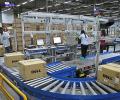
'We have the geographic advantage, demographic advantage, we have the necessary technical skills.' 'We just have to get all of these together. Then, we can very well compete.'

Modi said Nepal and India can benefit if they cooperate and work together for the promotion of five Ts: Tradition, Trade, Tourism, Technology and Transport.
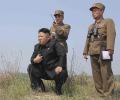
The missile was launched at 23:41 North Korea time from Jagang province in the north of the country, South Korean news agency Yonhap reported.
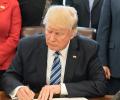
India needs to consider whether the Donald Trump administration can actually deliver, observes former foreign secretary Shyam Saran.
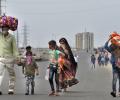
'While the poor have little say in shaping India's intellectual or public discourse, they do have a significant role in deciding political outcomes,' points out Roshan Kishore.

'China's moves are of direct significance to India, which will closely monitor Chinese naval activity in the Bay of Bengal and the Indian Ocean not least because of Chinese maps depicting claims over the Andaman and Nicobar Islands.'

'Poverty-stricken and drought-affected families in Bundelkhand and Marathawada are selling their children for as little as a few hundred rupees.'

'In terms of growth rate, India is better than China.'
.jpg)
Modi government has taken some interesting policy decisions in the 100 days since the time he met President Pranab Mukherjee to present his claim as Prime Minister of the world's largest democracy, says Tanmaya Nanda.
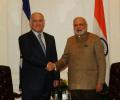
Modi's visit is aimed at commemorating 25 years of establishment of diplomatic ties between the two countries.

Both protesters and the authorities in Hong Kong are using complex combinations of technology, reports Devangshu Datta.

Sachin Bansal, who had co-founded Flipkart with Binny Bansal in 2007, would exit the company

Modi, who is undertaking his first visit to China as prime minister, will reach the ancient city of Xi'an, the home town of President Xi Jinping, for a summit meeting, an unusual departure from normal protocol and seen as a reciprocal gesture by the Chinese leader who was hosted by Modi in Ahmedabad when he visited India in September last year.

'The BRICS anthem has to necessarily be an anthem of Vedic times -- Walk together, Dream together, Achieve together.' 'And who knows it better than Modi?' says Tarun Vijay.

India on Monday voiced its concern to China over its plan to build a multi-billion dollar Economic Corridor to Pakistan through POK, even as it assured Beijing of its commitment to consolidate strategic bilateral ties.

'Xi Jinping is keen that the second Trump-Kim summit happens soonest.' 'Kim is reported to have told Xi that he expects to achieve a result from a second summit that the international community would welcome,' points out Dr Rajaram Panda.


'China might soon have to seriously consider whether it prefers an Indo-US hyphenation to a Sino-Indian one.'

'President Obama will make a historic visit to India in January, becoming the first US head of State to attend India's Republic Day and the only sitting US president to visit India twice.' 'There's little doubt the relationship has been re-energised, with renewed enthusiasm to take our partnership to the next level.'

The startling story of how a bitter ex-girlfriend helped capture artifacts raider Subhash Kapoor.

Mata Amritanandamayi's hospital has developed protein nanomedicines for drug-resistant leukemia and nano-structured wafers to prevent recurrence of brain tumours
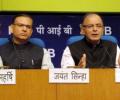
All credit to the finance minister for walking the fiscal and expectation tightrope extremely well in his budget speech, says Ganesh Natarajan.
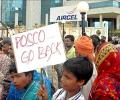
The government is working to expedite clearances to $12 billion project of steel major Posco in Odisha that was awarded environment clearance last week, Commerce and Indutry Minister Anand Sharma said on Tuesday.

Under siege, Nitish plans to tweak Bihar's anti-booze law

Make in India has few advantages and some disadvatnages too.

'There is an effort of painting the entire problem as religious one.' 'That Jammu and Kashmir is the way it is because the valley has radicalised.' 'I would be the first person to accept that there is a greater element of radicalism today than it was 25 years ago, but to suggest the entire valley of Kashmir is radicalised and everything you see on the ground is because radical Islam has suddenly taken over is not true.' Omar Abdullah, former J&K chief minister, explains why 'the situation in J&K is very worrisome.'
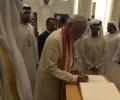
'Here is a man who can steer the country out of the woods. That sense of hope towards Modi was already there. And now that he has actually visited this region, it will go to the next level.' Zafar Sareshwala, a close confidant of Prime Minister Narendra Modi, shares his impressions about the PM's historic visit to the United Arab Emirates.
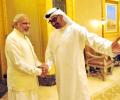
Apart from key bilateral issues, the two leaders also discussed situation in the region, particularly in wake of the increasing threat of terrorism and extremism from various sources including the Islamic State militant group.
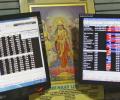
Optimism about a stable govt at the Centre, a demand revival and falling oil prices buoyed the markets.

With Beijing having had a profound rethink on India's admission as a full member of the Shanghai Cooperation Organisation, the tectonic plates of the geopolitics of a massive swathe of the planet stretching from the Asia-Pacific to West Asia are dramatically shifting. That grating noise in the Central Asian steppes will be heard far and wide -- as far as North America, says Ambassador M K Bhadrakumar.

We present our alphabet of 2020, pulling in everything you'll remember about this year we'd rather forget.

President Pranab Mukherjee on Monday addressed the first joint sitting of Parliament as mandatorily required under the Constitution after the general elections. The address is the political, economic and foreign policy road map of the Narendra Modi government and covers virtually all crucial areas.

'The Chinese mindset and approach to India is far different from that in Pakistan.' 'This reality makes it possible for us to follow an engagement policy with one, while militating against engagement with the other.'

'Flush with funds, lending became a cash management exercise.' 'Road projects, power generation plants, airports etc were financed left and right with apparently no regard for the projects' ability to repay,' explains S Muralidharan, former managing director, BNP Paribas.

Addressing the Indian diaspora on the second day of his three-day visit to Malaysia, Modi said India draws strength from its diversity and that his government is working to create an environment where enterprise flourishes and everybody gets basic needs like roof, sanitation, water, health care and education.

'... For the India-US relationship to continue its positive trajectory, it will require India to adapt to a different approach.' Nisha Desai Biswal -- who as the Obama administration's point person for South Asia was in the inner circle of all the Obama-Modi Summits -- tells Rediff.com's Monali Sarkar why she is hopeful that India and the US are on an irreversible forward course.
